
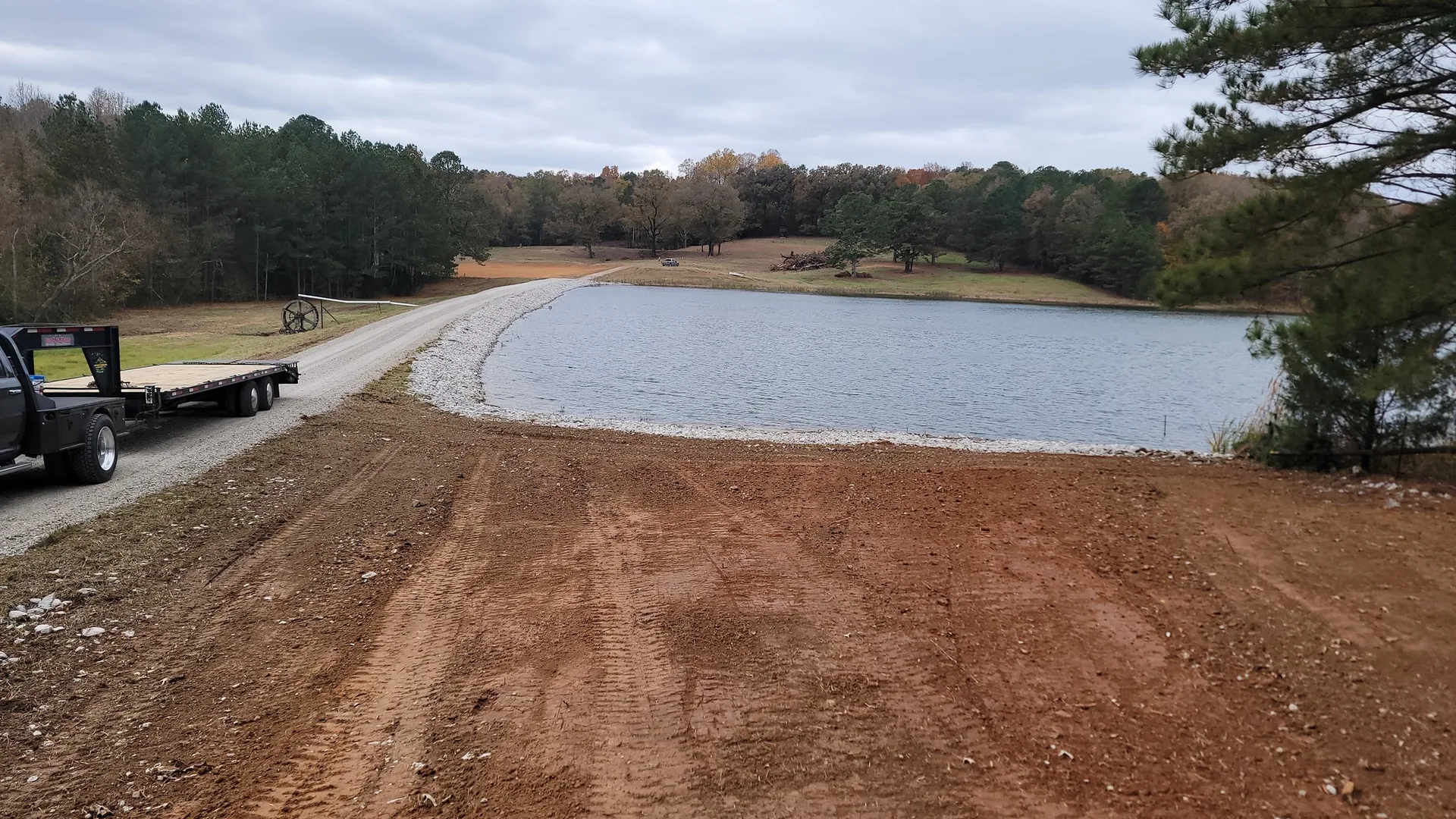
How Much Does It Cost to Dig a Pond in Alabama?
Most farm ponds land somewhere between about $5,000 and $25,000. National cost guides put a typical farm pond at $3,750 to $13,000. The same guides put a full one acre pond at $7,000 to $25,000. Small ponds cost more per acre than big ones do.
Those are published market numbers, not our price list. Your ground sets your number. The only way to get it is to have someone look at the site.
What does a pond cost per acre in Alabama?
Per surface acre, the published spread is wide. A pond up to half an acre is quoted at $4,000 to $25,000. Man made lakes run about $3,500 to $11,000 an acre. Past ten acres, per acre pricing drops toward $1,400 to $4,800.
That spread is not random. It tracks how much dirt has to move. Once you see what a pond dig involves, the pattern makes sense. Machine hours are the bill.
| What you are pricing | Published market range |
|---|---|
| Farm pond, typical project | $3,750 to $13,000 |
| Pond up to half an acre | $4,000 to $25,000 |
| One acre pond | $7,000 to $25,000 |
| Ten acres and up, per surface acre | $1,400 to $4,800 |
| Bulk excavation, per cubic yard | $1.50 to $3.50 |
| Trackhoe and operator, per hour | $100 to $300 |
| Pond cleanout, per cubic yard of muck | $10 to $60 |
| Pond cleanout, one acre pond | $5,000 to $20,000 |
Every range in that table comes from national cost guides published in 2025 and 2026. None of it is an Alabama quote, and none of it is ours. Guides also note a minimum job charge on most excavation work, often $500 to $800. Small jobs never scale all the way down.
What drives the price of digging a pond?
Alabama Cooperative Extension answers this in its pond building guide. The largest single factor controlling the cost is the amount of earth moving required. Clearing, pipe, concrete and seeding are small next to the dirt.
Extension is just as plain about the site itself. The lay of the land decides the final cost more than any other single factor. Two ponds the same size on two pieces of ground are two different jobs.
Will your ground hold water?
This is the cost question that sneaks up on people. Alabama Extension rates clay and silty clay as excellent for ponds. Coarse sands and sand gravel mixtures do not hold water well. Extension looks for an impervious layer at least 2 feet thick under the pond.
When the soil is wrong, the fix is the expensive part. Extension warns that sealing a pond bottom can be very expensive, since it usually means hauling in clay or bentonite. Limestone country adds its own risk here. Hidden crevices, sinkholes and caverns can leave you with a badly leaking pond. Test holes in the basin are worth digging first.
How much dirt is in a pond?
This is where the money comes from. One surface acre is 43,560 square feet. Dig that acre to an average depth of 8 feet and you move close to 12,900 cubic yards of dirt.
Now the shape of the land matters. A pond built by damming a draw only moves the dirt in the dam. A pit pond cut into flat pasture moves every yard of the basin.
Extension’s ideal site is a narrow neck of valley just below a wide bowl. A dam across that neck holds a lot of water for a modest amount of dozer work. Flat ground gives you none of that help.
What makes a North Alabama pond cost more?
Rock is the local one. The Tennessee Valley sits on shallow limestone and chert. Rock in the basin slows every pass, and rippers on the trackhoe add hours to pull it.
Spoil is the next one. Dirt out of the hole has to go somewhere. Spread on the property it is cheap. Loaded up and hauled off by the load it becomes a line item of its own.
Access counts too. Gates, creeks, fences and soft approaches all take time before a bucket ever moves. Machines and trucks have to reach the water line, same as any other dirt work job in North Alabama. Wet winters and springs can also shut a site down and push work to drier months.
Can you get help paying for a pond?
Sometimes. Extension says pond cost is sometimes shared through government programs. That applies when a pond cuts downstream pollution or supplies water for livestock. Ask your local Soil and Water Conservation District office and the NRCS.
USDA’s Natural Resources Conservation Service prices pond building by the cubic yard in its Alabama payment schedules.Those are cost share rates rather than market prices, and they get reset every year.
How do you keep a pond price from getting away from you?
Pick the site first. Extension says cutting corners at the site stage comes back on the owner later. Sealing a bottom that will not hold water gets expensive fast.
Extension also suggests pricing the individual items rather than paying by the hour. The hours are outside the owner’s control. Ask what a number covers: clearing, the dig, the bank, the spoil and the cleanup.
Then check the rules before dirt moves. Extension points pond owners to NRCS or the Army Corps of Engineers on whether a site can be dammed. Call Alabama 811 first so buried utilities get marked. Where a pond needs a designed dam or a sized overflow, that plan comes from NRCS or an engineer.
Getting a real number for your ground
Published ranges tell you the shape of the market. They cannot see your slope, your soil or your rock. A pond quote is really a dirt quote, and dirt has to be measured on site.
We look at the ground, talk through the water you want to hold and give you a free estimate. Call or text (256) 303-7210 when you are ready to dig, enlarge or clean out a pond on your place.